 (248) 376-8991




How to Choose the Best Fertilizer for Your Lawn: Professional vs. DIY Store Brands
![[HERO] How to Choose the Best Fertilizer for Your Lawn: Professional vs. DIY Store Brands](https://cdn.marblism.com/PuFAJAvDoEI.webp)
It’s mid-April here in the neighborhood, and if you’re like most of us at Sunnydale Lawn Care, you’ve probably spent the last few Saturdays staring out the window at your grass, waiting for that first real pop of green. The air is getting warmer, the birds are back, and the local big-box stores have moved those massive pallets of bright yellow and green fertilizer bags right to the front of the garden center.
It’s tempting, isn’t it? You grab a cart, hoist a couple of bags, and figure a Sunday afternoon with a spreader is all it takes to get that golf-course look. But before you break your back loading up the SUV, we want to share some professional insight. Choosing the right nutrients for your lawn isn't just about grabbing a bag that says "Green Up"; it’s about understanding the science of your specific soil.
At Sunnydale Lawn Care, we see the results of both DIY efforts and professional programs every day. While DIY can be a hobby for some, there are significant differences in the health, safety, and longevity of your lawn when you choose a professional fertilization and weed control program.
The "One-Size-Fits-All" Trap of Store Brands
The biggest challenge with store-bought fertilizer is that it is formulated for the "average" lawn across the entire country. However, a lawn in Michigan has vastly different needs than a lawn in Georgia or even a few towns over.
When you buy a bag off the shelf, you’re getting a generic N-P-K ratio (Nitrogen, Phosphorus, and Potassium). Nitrogen helps with the green color and leaf growth, Phosphorus supports root development, and Potassium aids in overall plant health and disease resistance. But without knowing what your soil actually lacks, you might be over-applying nutrients your lawn already has in abundance, which can lead to runoff and environmental stress.
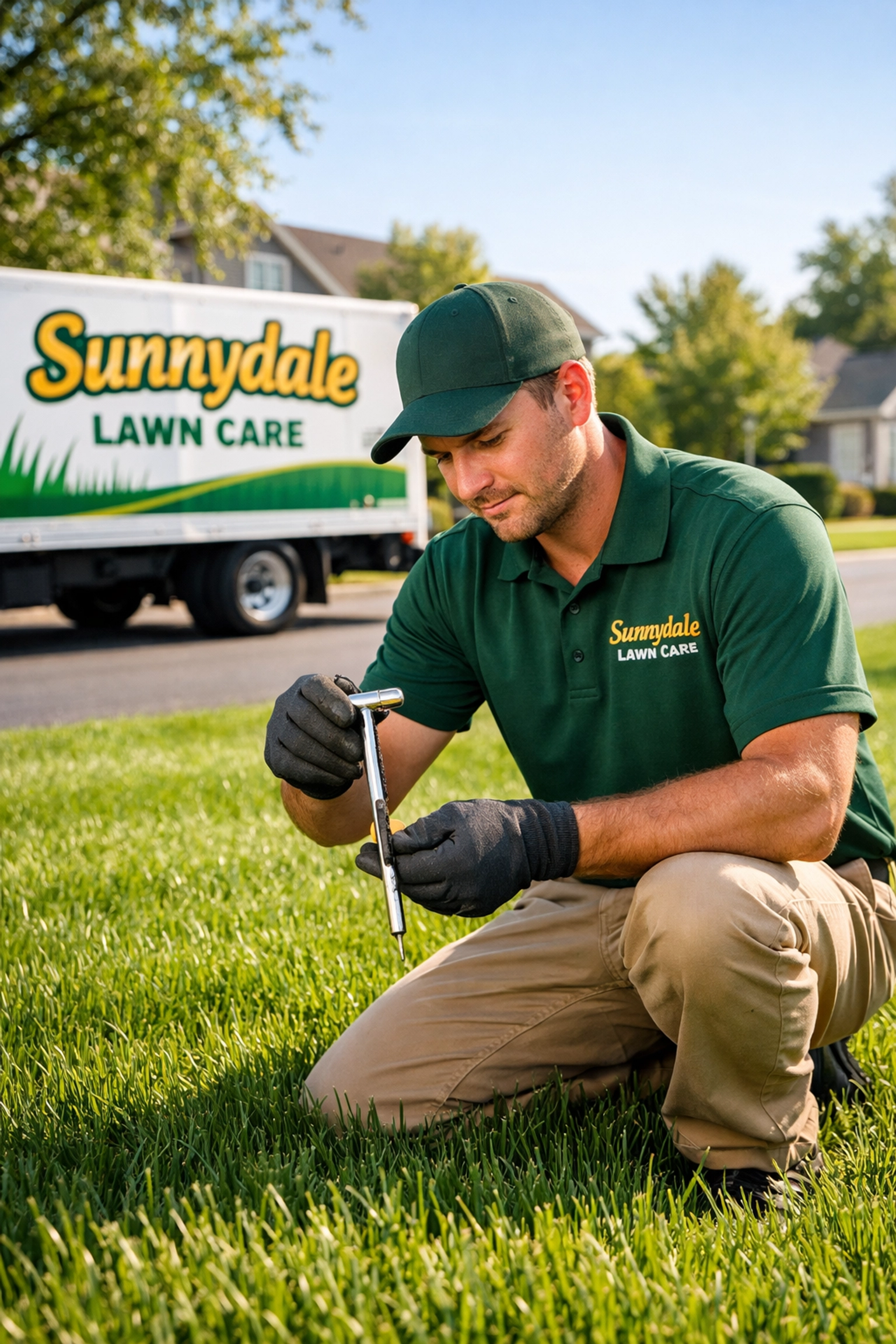
A Sunnydale Lawn Care technician, wearing a branded company shirt, carefully inspects a lawn's soil health. A professional Sunnydale truck is parked neatly at the curb in the background.
Frequently Asked Questions: Pro vs. DIY
We get a lot of questions this time of year about why homeowners should make the switch. Here are the most common things we discuss:
1. Is professional fertilization actually more expensive?
When you look at the sticker price of a single bag of fertilizer, DIY looks cheaper. But when you factor in the cost of a high-quality spreader, the time spent hauling and applying product, and the risk of "fertilizer burn" (which can cost hundreds to repair), the gap closes quickly. Professionals buy commercial-grade products in bulk and use calibrated equipment that ensures not a single grain of product is wasted. For most of our neighbors, the price difference is surprisingly small compared to the value of their time.
2. Why does my DIY fertilizer wear off so fast?
Many retail brands use high concentrations of "fast-release" nitrogen. This gives you a quick surge of growth and a deep green color for about two weeks, but then it pales out. It’s like a sugar rush for your grass. We prefer slow-release formulations. These provide a steady "trickle" of nutrients over several weeks, leading to stronger roots and more consistent color without the constant need for mowing.
3. Are professional treatments safe for my family and pets?
This is a huge concern for us. We avoid using harsh "killer" chemicals. Instead, we focus on targeted weed treatments and soil conditioners that promote a thick, healthy turf. A thick lawn is naturally more resistant to weeds and pests. When we apply treatments, we provide clear instructions on when it's safe to return to the grass: usually just as soon as the liquid treatments have dried.
The Science of Timing and Soil Temperatures
In lawn care, timing is everything. Applying fertilizer too early in the spring can actually hurt your grass. If the ground is still too cold, the grass isn't "awake" enough to uptake the nutrients. The nitrogen then just sits there, potentially leaching into the groundwater or feeding early-season weeds.
As of today, April 11th, we are right in the window where soil temperatures are starting to climb. We monitor local weather patterns and soil probes to ensure we are hitting the lawn at the exact moment it needs fuel. Our Michigan spring fertilization schedule is built around these local climate nuances, not a generic calendar on the back of a bag.

A close-up of lush, vibrant green grass being treated with a professional-grade liquid application. No mowing equipment is visible, emphasizing the care and precision of the nutrient application.
Precision Equipment: The Unsung Hero
Even if you buy the best fertilizer in the world, it won't matter if you apply it unevenly. We’ve all seen "striped" lawns where one row is neon green and the next is yellow. This is usually caused by an uncalibrated homeowner spreader or overlapping rows too much.
Professional equipment, like the ones we use at Sunnydale Lawn Care, is calibrated specifically for the density and weight of the product being used. Whether it's a granular application or a liquid nutrient blend, our technicians are trained to ensure 100% even coverage. This prevents "burning" the grass with too much nitrogen in one spot and leaving "weak spots" in another.
Why Weed Treatment Matters Alongside Fertilization
You can’t talk about fertilizer without talking about weed control. If you fertilize a lawn full of dandelions and crabgrass, you’re essentially just feeding the weeds.
Professional services offer a dual-pronged approach. We use pre-emergent treatments to stop weeds before they even break the surface and post-emergent spot treatments for the stubborn ones that do. By choosing a fertilization and weed control package, you’re ensuring that the nutrients you're paying for are going directly to your grass, not the weeds.
The Sunnydale Difference: What’s in our Trucks?
- Custom Blends: We don't use the same bag on every lawn. We adjust based on sun exposure, soil type, and grass variety.
- Safety-First mindset: We use the most modern, responsible products available to keep your yard a safe place to play.
- Expert Eyes: Our technicians aren't just "applicators"; they are trained to spot signs of lawn insects and disease before they become disasters.
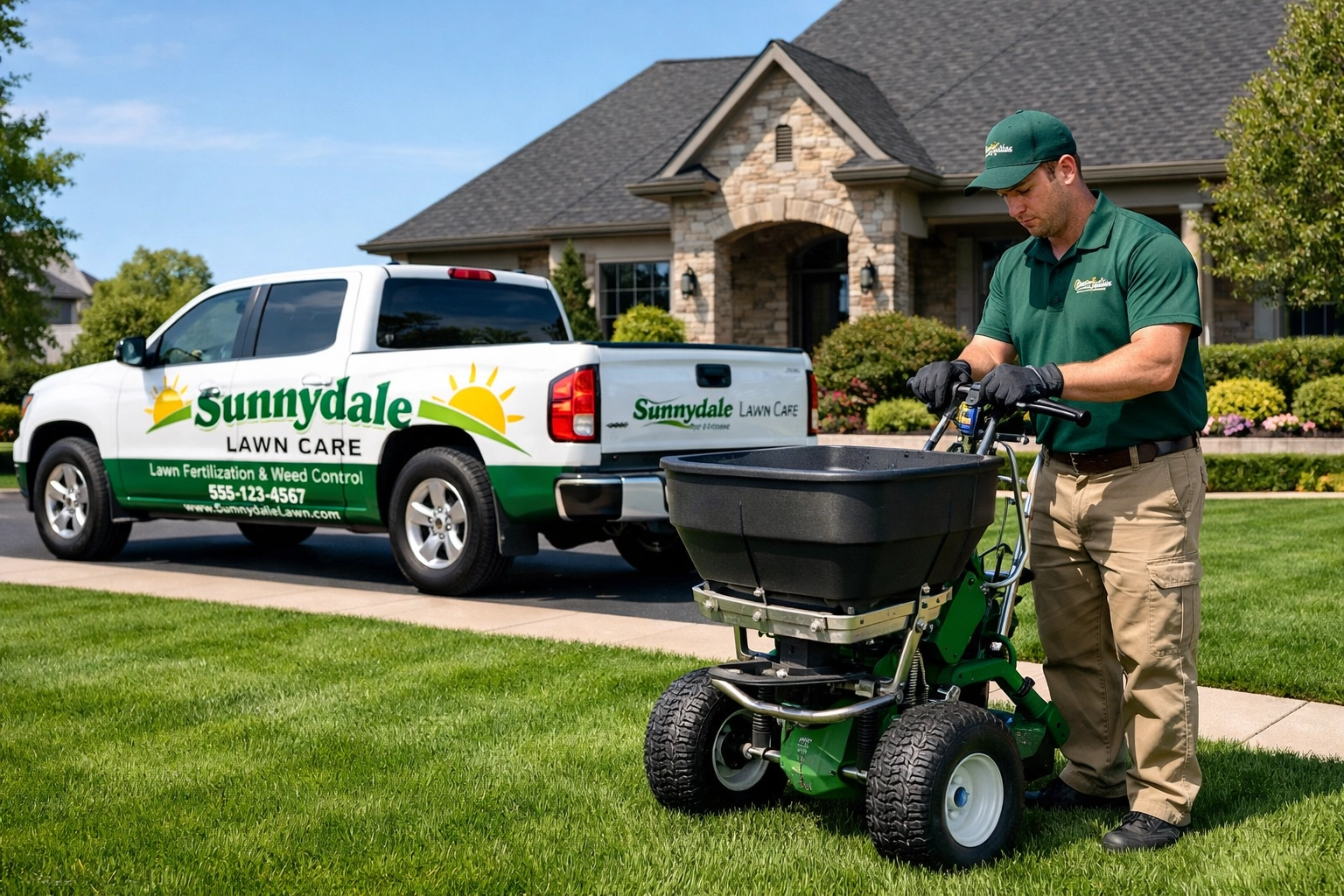
A Sunnydale Lawn Care truck parked in a residential driveway. The technician is visible in a professional uniform, adjusting the settings on a granular spreader. The focus is on the professional equipment and branding.
Is It Time to Hang Up the Spreader?
If you enjoy the workout and the trial-and-error of DIY lawn care, there’s plenty of information out there to help you. But if you want a guaranteed result, a healthier environment, and more free time on your weekends, professional care is the way to go.
We take a lot of pride in the lawns we service. Seeing a yard transform from a patchy, weed-filled lot into a lush, soft carpet of green is why we do what we do. Plus, when you hire a local pro, you’re getting someone who knows the local soil conditions like the back of their hand.
If you’re ready to see what a professional touch can do for your curb appeal this spring, we’d love to help. You can check out our areas served to see if we’re in your neighborhood, or feel free to contact us for a free estimate.
Key Takeaways for April:
- Soil Temp Matters: Don't rush the first application if the ground is still frozen or soggy.
- Avoid "Killers": Look for "weed control" and "treatments" that are gentler on the ecosystem.
- Consistency is King: A one-time application won't carry you through the summer. A 5-6 step program is ideal for most lawns.
- Think Roots: Healthy lawns start underground. Consider aeration and seeding if your soil is compacted.
Your lawn is an extension of your home. Whether you choose to do it yourself or give us a call, make sure you're giving it the specific nutrients it needs to thrive this season!

Comments (0)
Thanks for your comment!
Thanks for your feedback! Your comments have been successfully submitted! Please note, all comments require admin approval prior to display.
Error submitting comment!
There is a problem with your comment, please see below and try again.